
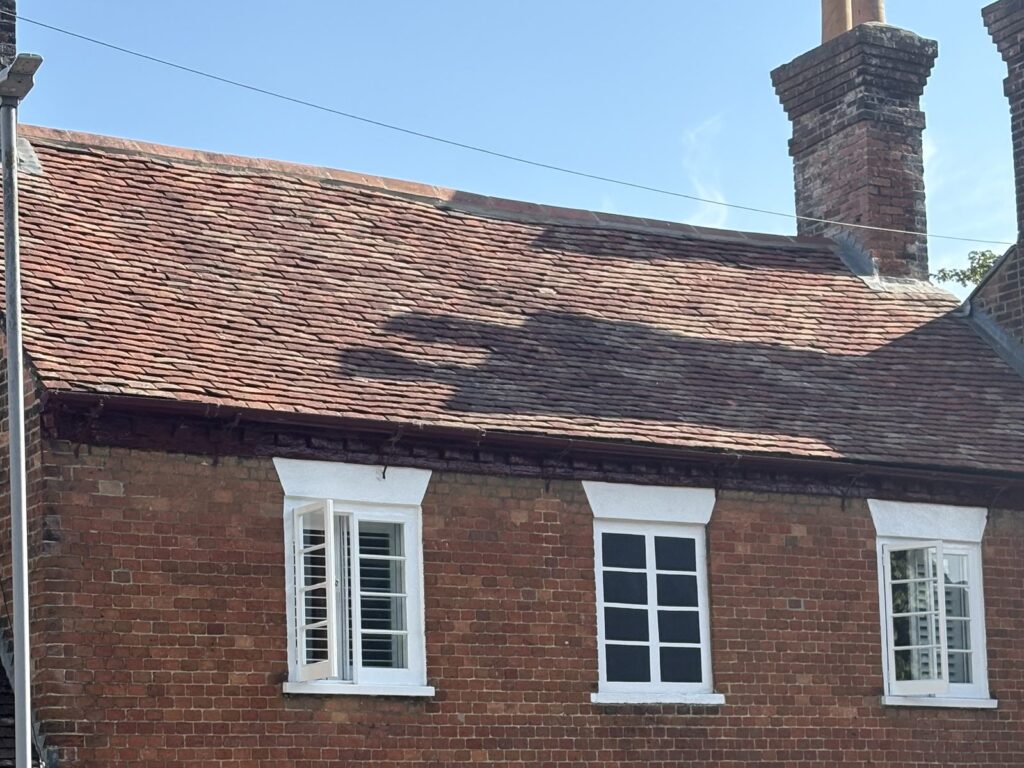
It’s the question we get asked most often, usually phrased something like: “Can’t you just jet wash it?”
The short answer is that you can. Plenty of companies will. But a roof is not a driveway, and treating it like one is one of the more expensive mistakes you can make on your home.
Here’s what actually happens when high-pressure water meets a tiled roof, and what to do instead.
A roof is designed to do one thing
Every part of a pitched roof works on the same principle: water arrives from above and runs downwards. Tiles overlap. Each course sits over the one below. Ridge and hip tiles cap the joins. The whole assembly sheds water by gravity, and it does it extremely well for fifty years or more.
What it is not designed to do is resist water travelling upwards or sideways under pressure.
A pressure washer produces somewhere between 1,500 and 4,000 PSI. Point that at the underside of a tile lap, and you’re doing something the roof was never built to withstand. That’s the root of every problem below.
What high pressure actually does
It strips the surface off concrete tiles
Most Dorset housing stock from the 1930s onwards is roofed with concrete tiles — Marley, Redland and similar. These have a dense, fine-textured surface layer, often with pigment worked into it, sitting over a coarser aggregate core.
That surface layer is the tile’s weatherproofing. Blast it with high pressure and it erodes, exposing the open, porous concrete beneath. The tile stops being smooth and starts being absorbent.
You usually can’t see it from the ground on the day. You see it two winters later.
It forces water where water shouldn’t go
Under pressure, water finds its way past tile laps, over the top of the underlay, and into the roof space. On older properties this matters more than people expect. Pre-1980s roofs often have bitumen felt that has gone brittle with age, and some Victorian and Edwardian roofs have no underlay at all — just tiles on battens, sometimes torched with mortar.
Water in a loft doesn’t announce itself immediately. It shows up as a damp patch on a bedroom ceiling in November, and by then nobody connects it to the roof clean in July.
It moves tiles
Tiles are held by gravity, by nibs hooked over battens, and sometimes by clips at the perimeter. They are not glued down. Sustained pressure at the wrong angle can lift them, shift them out of alignment, or crack the nib clean off — at which point the tile is only staying put because its neighbours are holding it.
The mortar bedding on ridges, hips and verges is even more vulnerable. It’s often decades old and already carbonated and friable. High pressure takes it out.
It sets up frost damage
This is the one that costs real money, and it’s entirely delayed.
Once a tile’s surface is opened up, it holds water. When that water freezes it expands by roughly nine percent, and the expansion happens inside the tile. Repeat that through a few Dorset winters and you get spalling — flaking, crumbling faces, and eventually tiles that fail outright.
A roof that looked fantastic the afternoon it was cleaned can need tiles replacing within five years.
It blocks the drainage you’ve just paid to protect
All that dislodged moss, grit and eroded tile surface has to go somewhere. It goes into the gutters, then into the downpipes, then into the gullies. We’ve seen roofs cleaned by pressure washing where the immediate follow-up job was clearing several kilos of silt out of a drainage system that had been working perfectly the week before.
The part that nobody mentions: it grows back faster
Here’s the irony at the centre of all this.
Pressure washing removes the moss you can see. It does not kill the spores, the lichen roots, or the algae film. And by roughening the tile surface, it gives everything that comes next a better key to grip and a more absorbent surface to grow on.
So the roof looks superb for a season, then greens up — often faster and more heavily than before, because the surface is now more hospitable than it was originally. Which is why a lot of people end up on a three-year cycle of increasingly damaging cleans.
Moss control is a biological problem, not a force problem. You solve it by killing what’s there and treating what’s coming, not by blasting the visible growth off and hoping.
So why is it still offered?
Not usually out of dishonesty. Two more mundane reasons.
The equipment is cheap and already in the van. Anyone doing driveways and patios owns a pressure washer. Roof work is a natural-looking add-on, and the machine is right there. Specialist roof equipment is a separate investment.
The result looks spectacular on the day. Instant, dramatic, photographs beautifully. The damage is slow, invisible from the ground, and shows up long after the invoice has cleared. There’s no feedback loop connecting the method to the consequence.
It’s worth adding: most tile manufacturers advise against high-pressure cleaning in their own technical guidance, and some are explicit that it can affect product warranties. Worth checking your own tiles if you know the make.
What we do instead
We don’t put water on your roof at all.
Our Marshall Pro/Air system uses compressed air to remove moss, lichen and organic debris mechanically. No pressure washing, no water forced under tiles, no saturated loft, no weight of water on the structure, and no risk of surface erosion. The debris comes off dry and is collected at ground level.
Once the roof is clear, we apply a biocide treatment that kills the remaining spores and root structures, and continues working for months afterwards. That’s what stops the regrowth — not the cleaning itself, but the treatment behind it.
The result is slower to photograph and less dramatic than a jet wash in progress. But the roof is intact, it stays clear for years rather than months, and you’re not storing up a tile replacement bill for 2031.
And we don’t stand on your tiles
Walking a tiled roof cracks tiles. It’s that simple — the load goes through a single point on a component designed to spread it.
We work from ground level and from proper access equipment. Adam’s background is in height safety engineering — inspecting and certifying fall-arrest systems to BS 7883 — so the safe way to reach a roof without damaging it is genuinely the day job, not an afterthought.
Five questions to ask anyone quoting on your roof
Whoever you use, these will tell you most of what you need to know:
- What method do you use? If the answer involves a pressure washer, ask what PSI and where they’ll point it.
- Will you be walking on the tiles? If yes, ask how they’ll spread the load.
- What treatment goes on afterwards? No biocide means the moss is coming back.
- What are my tiles made of, and does that change your approach? Concrete, clay and natural slate all behave differently. A good answer here tells you a lot.
- Are you insured for working at height, and can I see it? Perfectly reasonable to ask. Any professional will have it to hand.
Dorset roofs specifically
We’re in one of the better parts of the country for moss and one of the worst for roofs.
Mild, wet winters, high humidity off the coast, and a lot of mature tree cover through Wimborne, Ferndown, Corfe Mullen and the villages — Colehill and Pamphill especially. North-facing pitches that never get direct sun stay damp for months at a stretch. Concrete tile, which dominates local housing stock, is exactly the substrate moss likes best.
Which means two things. Roofs here need clearing more often than the national average. And because they’ll be cleaned repeatedly over the life of the roof, the method you choose compounds. Three gentle cleans leave a roof in good order. Three pressure washes take years off it.
If your roof needs looking at
We cover Wimborne, Poole, Ferndown, Broadstone, Corfe Mullen, Verwood, West Moors and the surrounding villages.
Quotes are free, done on site rather than over the phone, and we’ll tell you honestly if your roof doesn’t need cleaning yet — sometimes it doesn’t.
Get a free quote or call us to talk it through.
Robertson Exterior Cleaning — Marshall Pro/Aircompressed air roof cleaning and biocide treatment across East Dorset. No jet washing. No foot on your tiles.